Samsung All Star Lineup Aamir Khan And Alia Bhatt In Tech Ads
Samsung’s All-Star Lineup: Aamir Khan & Alia Bhatt in Tech Ads
Explore how Samsung uses Bollywood star power with Aamir Khan and Alia Bhatt to build memorable tech campaigns, connect with Indian audiences, and make smartphones more aspirational through celebrity-led advertising and influencer marketing.
Do You Own A Brand or Business?
Boost Your Brand's Reach with Top Celebrities & Influencers!
Share Your Details & Get a Call Within 30 Mins!
Thank You for Your Enquiry!
We’ve received your details and will connect with you soon!
Your information is safe with us
Samsung has never treated smartphones as just pieces of technology. The brand has often connected its products with lifestyle, entertainment, creativity, and popular culture. And in India, Bollywood celebrities have played a big role in making that connection stronger.
From Aamir Khan’s Samsung campaigns in the late 2000s to Alia Bhatt becoming the face of Samsung’s premium foldable smartphones, celebrity marketing has helped Samsung make technology feel more relatable.
The story becomes even more interesting when Shah Rukh Khan enters the picture. During the 2008 mobile-phone rivalry, Shah Rukh Khan was associated with Nokia while Samsung signed Aamir Khan. This created a memorable “Khan vs Khan” battle in the smartphone advertising space.
Today, Samsung’s association with Alia Bhatt shows how the brand has moved towards a younger, more lifestyle-focused audience.
India’s Huge Smartphone Market
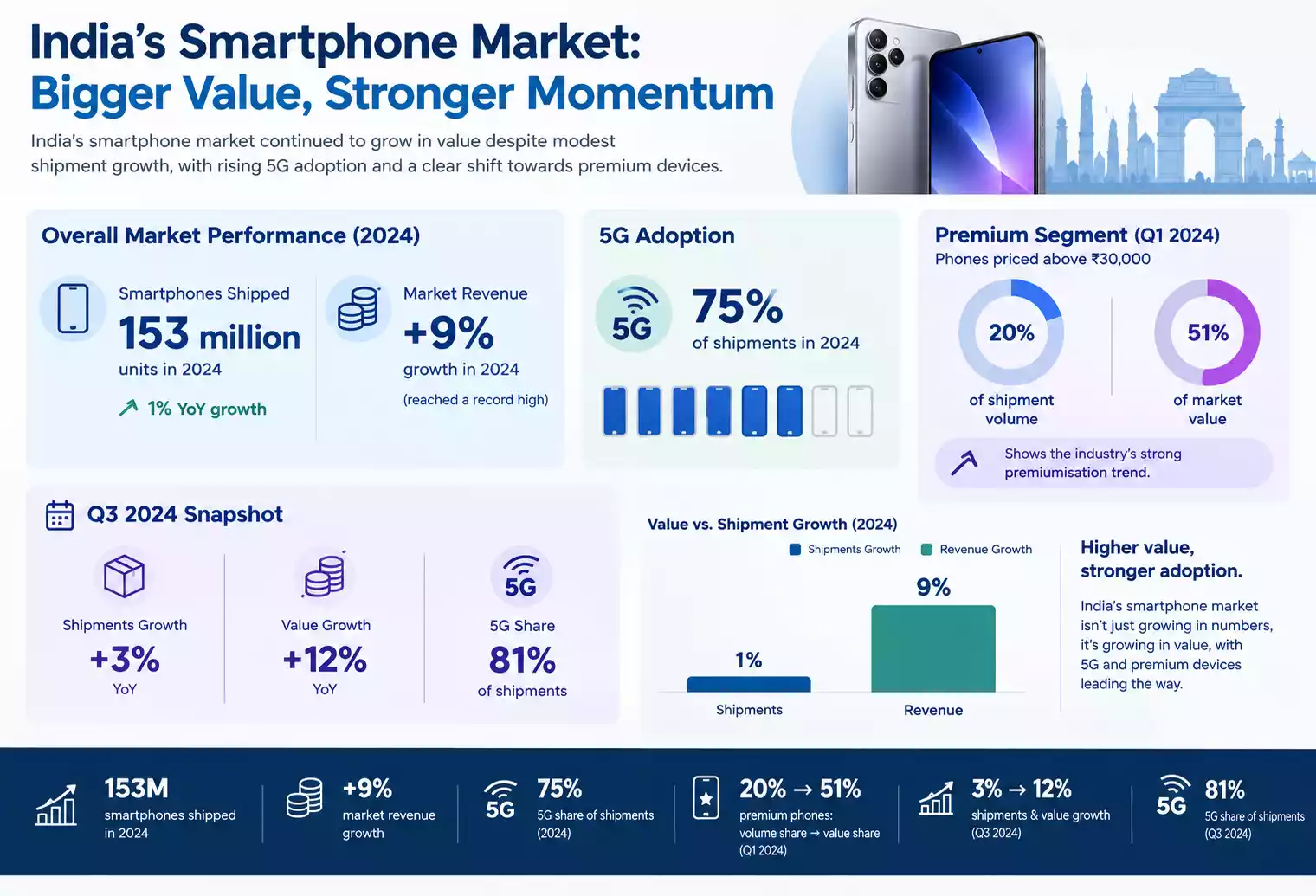
India’s smartphone market continued to grow in value despite relatively modest shipment growth, with 153 million smartphones shipped in 2024, representing a 1% year-on-year increase, while market revenue grew by 9% to reach a record high. The market is also seeing rapid adoption of 5G and premium devices, with 5G smartphones accounting for around 75% of shipments in 2024.
Premium smartphones priced above ₹30,000 represented 20% of shipment volume but contributed 51% of market value in Q1 2024, highlighting the industry’s strong premiumisation trend. By Q3 2024, smartphone shipments grew 3% YoY, while market value increased by 12%, with 5G devices accounting for 81% of shipments.
This is relevant to smartphone marketing because smartphones have increasingly become lifestyle products too. People care about how a phone looks, how it fits into their personality, how good its camera is, and how it looks in their hands.
That is exactly where celebrities can make a difference.
Why Smartphone Brands Need Celebrities and Influencers?
Smartphone brands have to explain a lot of technical features. Cameras, processors, displays, AI tools, battery life and foldable designs can easily sound complicated.
Celebrities make these features easier to understand by showing how the product fits into everyday life. Influencers take this one step further by demonstrating the phone in real situations and creating content that feels more personal.
For smartphone brands, the combination is powerful: celebrities create attention, while influencers create conversation and trust.
Aamir Khan and Samsung: The Beginning of a Rivalry!
Aamir Khan became Samsung’s mobile brand ambassador in 2008. Samsung positioned him around ideas such as innovation, change, discovery, self-expression and performance.
At the time, Shah Rukh Khan was already endorsing Nokia. Samsung’s decision to bring Aamir on board therefore created an interesting advertising rivalry.
It was not simply about two actors.
It was about two major mobile brands competing for the attention of Indian consumers.
Samsung used Aamir’s personality to support its “Next is What?” positioning. One of the early campaigns featured him promoting the Samsung Beat450 music phone, with the commercial focusing on the experience of listening to music rather than simply listing product features.
This was a smart approach. Instead of saying, “Here are the features,” Samsung showed consumers what the phone could make them feel.
A behind-the-scenes video of Aamir Khan’s Samsung mobile advertisement is available on YouTube:
The campaign also became part of the wider Khan-versus-Khan mobile advertising story, with Aamir representing Samsung and Shah Rukh Khan representing Nokia.
Shah Rukh Khan, Aamir Khan and the Samsung-Nokia Rivalry
It is important to get one detail right here.
Shah Rukh Khan was not Samsung’s brand ambassador during this famous 2008 rivalry. He was endorsing Nokia, while Samsung had signed Aamir Khan.
That rivalry, however, shows how valuable Bollywood stars had become for technology brands.
Both Samsung and Nokia were competing in a market where consumers were not just buying phones. They were buying status, design, entertainment and identity.
Celebrity endorsements helped brands turn a technical product into something people could emotionally connect with.
Interestingly, Samsung also used marketing tactics around Nokia’s campaigns later, including activity around the launch of Nokia’s Lumia smartphones. The competition between the two brands became one of the more memorable examples of mobile-phone marketing in India.
Alia Bhatt: Samsung’s New-Age Celebrity Strategy
Fast forward to 2021, and Samsung took a very different approach.
The company signed Alia Bhatt as the face of its premium Galaxy Z Fold3 5G and Galaxy Z Flip3 5G smartphones in India. Samsung specifically highlighted her popularity among Gen Z and millennial audiences.
This made sense for the product.
Foldable phones were not being positioned as ordinary smartphones. They were being presented as stylish, premium and different.
And Alia’s image worked well with that positioning.
The campaign was not only about showing the phone. It was about showing how the phone could fit into a modern lifestyle.
Samsung later continued its partnership with Alia for the Galaxy Z Flip4 and Galaxy Z Fold4.
#FlexEveryAngle: Technology Meets Lifestyle
In 2022, Samsung launched its #FlexEveryAngle campaign featuring Alia Bhatt.
The campaign showed Alia using the Galaxy Z Flip4 at a colourful carnival. The focus was on features such as FlexCam and Nightography, but these features were presented through everyday experiences rather than technical explanations.
Instead of telling consumers that a camera can capture better low-light images, Samsung showed a celebrity actually using the camera in an exciting environment.
Instead of simply explaining the flexibility of a foldable phone, the campaign showed Alia using it in different situations.
The video ad was published by Samsung India and focuses on how the Galaxy Z Fold3 can work as a theatre, workspace and gaming device in a compact form.
Samsung’s official newsroom also confirmed that Alia’s campaigns included digital, outdoor, hyperlocal and data-driven activations.
From Bollywood Star Power to Influencer Marketing
There is another important change in Samsung’s strategy.
Earlier, celebrity advertising was heavily dependent on television commercials, outdoor advertising and traditional media.
Today, a celebrity campaign can travel across Instagram, YouTube, short-form video, creator content and digital advertising within hours.
Samsung itself has experimented with creator-led campaigns. Its #IndiaReadyAction campaign, for example, encouraged young Indians to create videos and share their view of the country. The campaign generated 161.8 million engagements on Instagram and Facebook in four weeks, with 59% of participants coming from non-metro cities.
This shows why celebrities and influencers work well together.
A celebrity can introduce the product to millions of people. Influencers can then demonstrate it in more relatable and specific ways.
One creates the big moment.
The other keeps the conversation going.
What Brands Can Learn From Samsung?
There are a few simple lessons here.
1. Pick a celebrity who fits the product
Aamir Khan represented innovation, performance and versatility for Samsung’s earlier campaigns. Alia Bhatt brought a younger, stylish and modern image to the Galaxy Z series.
The celebrity should fit the product rather than simply being famous.
2. Sell the experience, not just the specifications
Smartphone advertisements can quickly become a list of features.
Samsung often avoided this by showing celebrities actually experiencing the product.
That makes the advertisement easier to remember.
3. Make technology feel aspirational
Foldable phones were still a relatively new category when Samsung partnered with Alia.
Showing the device through a popular celebrity helped position it as something stylish and desirable rather than simply experimental technology.
4. Combine celebrities with creators
The modern consumer does not only watch television commercials.
They watch Reels, Shorts, YouTube videos and creator reviews.
That is why a strong celebrity campaign can become even more effective when supported by influencers and digital creators.
Conclusion
Samsung’s celebrity marketing story shows how much smartphone advertising has changed in India.
Aamir Khan helped Samsung create a strong identity around innovation during the brand’s battle with Nokia. Years later, Alia Bhatt helped Samsung present its foldable phones as stylish, modern lifestyle products.
And while Shah Rukh Khan was on the Nokia side of that famous Khan-versus-Khan rivalry, his presence shows just how important Bollywood star power was to the mobile-phone category.
The bigger lesson is simple: people connect with people before they connect with products.
For businesses and brands looking to build the same kind of attention, Tring is a go-to platform for booking celebrities and influencers for brand promotion, campaigns, events and marketing collaborations. The right celebrity can help a campaign get noticed, while the right influencer strategy can keep the conversation going.
Do You Own A Brand or Business?
Boost Your Brand's Reach with Top Celebrities & Influencers!
Share Your Details & Get a Call Within 30 Mins!
Thank You for Your Enquiry!
We’ve received your details and will connect with you soon!
Your information is safe with us
Frequently Asked Questions
When did Aamir Khan collaborate with Samsung?
Aamir Khan became Samsung’s mobile brand ambassador in 2008. He featured in campaigns for Samsung mobile phones, helping the brand communicate innovation, entertainment, and new technology to Indian consumers.
When did Alia Bhatt become associated with Samsung?
Samsung signed Alia Bhatt as the face of its Galaxy Z Fold3 5G and Galaxy Z Flip3 5G in India in 2021. Samsung highlighted her popularity among Gen Z and millennial audiences as a reason for the partnership.
What was Samsung’s #FlexEveryAngle campaign with Alia Bhatt?
The #FlexEveryAngle campaign featured Alia Bhatt with the Galaxy Z Flip4 and Galaxy Z Fold4. The campaign showed how the foldable phones could support photography, videos, entertainment, and self-expression in everyday situations.
Why did Samsung choose Aamir Khan for its mobile campaigns?
Aamir Khan had a strong reputation for versatility and innovation, which matched Samsung’s positioning at the time. His popularity also helped Samsung stand out in the competitive Indian mobile-phone market.
Which Samsung phones did Alia Bhatt promote?
Alia Bhatt promoted Samsung’s Galaxy Z foldable range, including the Galaxy Z Fold3 5G, Galaxy Z Flip3 5G, Galaxy Z Fold4 and Galaxy Z Flip4. She also appeared in campaigns highlighting features such as FlexCam and Nightography.
How did Samsung use Alia Bhatt beyond traditional smartphone advertising?
Samsung also worked with Alia Bhatt on its #UnfoldYourWorld campaign with designer Masaba Gupta. The campaign connected Galaxy foldables with sustainability and the UN Sustainable Development Goals, showing how the phones could be part of a creative project.


 Birthday Gifts
 Women
Women
 Men
Men
 Anniversary Gifts
 Wedding Gifts
 Search from 15000+ celebs


 We now support international payments