Understanding the Partnership
Bata's own announcement was specific about its reasoning. Gunjan Shah, then CEO of Bata India, said the brand had been "on a quest to transform the brand imagery and deliver on the aspirations of the youth of the country," describing Disha Patani's "lively personality and positive energy" as fitting "perfectly with our brand narrative that blends together style and comfort." The company also framed her signing within a broader shift, noting it was rolling out more sneakers, casual styles, and fashion-forward footwear, and that her association would help deepen its connection with youth and millennial shoppers specifically.
A few factors explain why this pairing made sense. Disha Patani's public image, built through contemporary Bollywood roles and a large social media following, gave Bata a face associated with current youth culture rather than an older, more traditional footwear-buying image. Her recognition as what the brand itself called "the face of next-gen Bollywood" matched Bata's stated ambition to reach younger consumers. And the timing coincided with an expanding product range across sneakers and casual styles, categories that benefit more from a fashion-forward face than Bata's traditional formal and school-shoe lines might.
Why Disha Patani Is a Strong Fit for Bata India
The distinction between celebrity visibility and celebrity-brand fit matters here. Many actresses could draw attention to a footwear campaign. Fewer carry a public image built specifically around fitness, versatile styling, and a youthful, energetic persona, qualities that map more directly onto footwear than a more glamour-focused public image would.
Disha Patani's own comments at the signing reinforce this fit. She described being "quite impressed with the wide variety of styles & designs across sneakers, casuals, and fashion footwear," saying it "excited the fashionista inside me." This response points to a specific alignment: her public persona already spans an active, sneaker-friendly lifestyle alongside more polished red-carpet appearances, mirroring Bata's own range across casual and dressier footwear categories. That versatility, rather than a single fixed style identity, is what makes her plausible across Bata's varied product lines rather than suited to only one narrow segment.
Disha Patani and Bata India Collaboration Ads
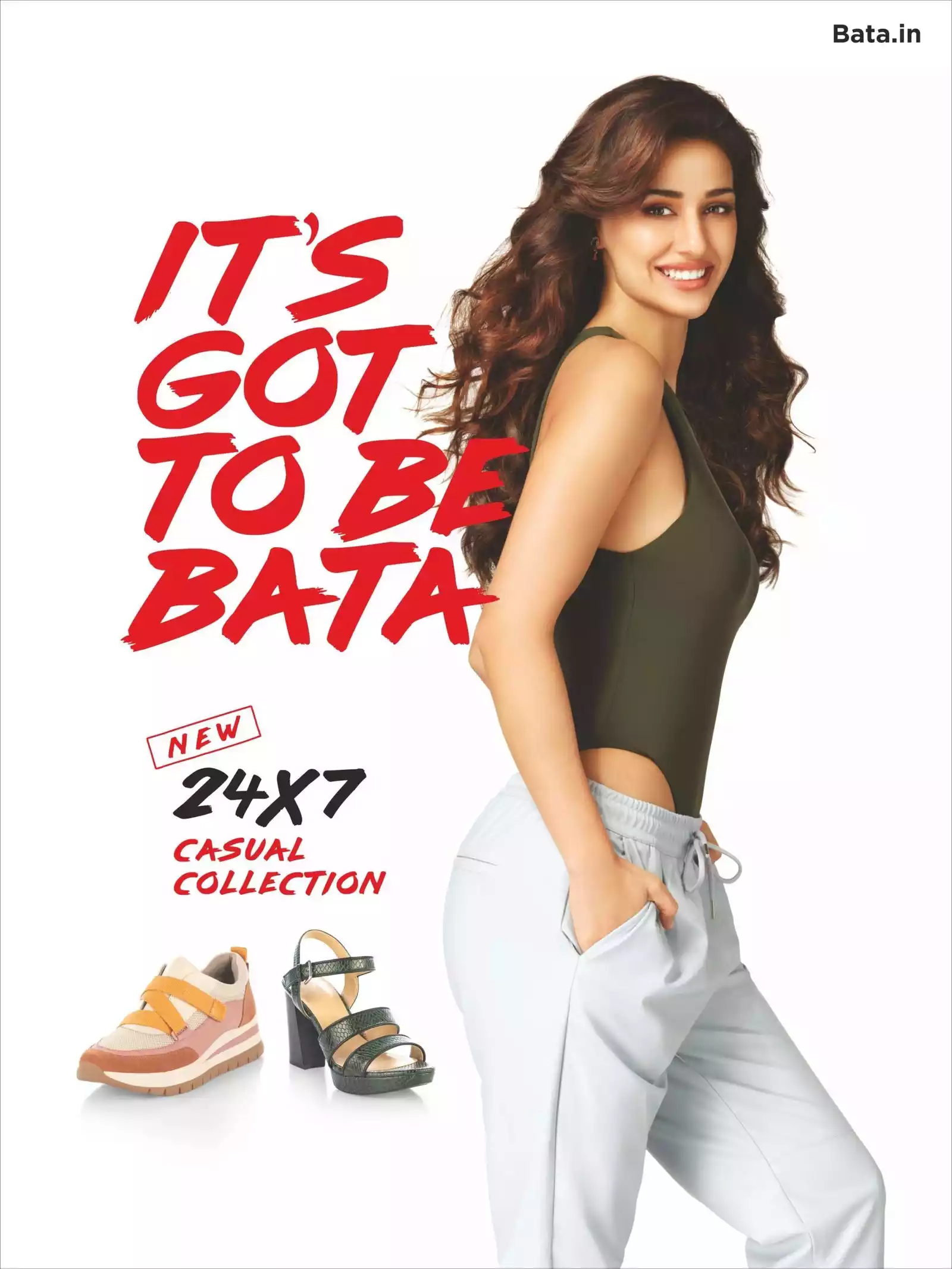
The clearest documented example of this partnership in action is "It's Got To Be Bata," a 360-degree campaign conceptualised by Contract Advertising and launched to introduce Bata's 24x7 Casual Collection. The collection spans the Bata, Bata Red Label, Bata Comfit, and Naturalizer labels, featuring artisanal-styled heels, wedges, and sneakers designed, in Gunjan Shah's words, for "the various roles that women play throughout the day."
This campaign is a useful example of how Bata integrated Disha Patani into a specific product story rather than a generic brand appearance. Shah explained the thinking directly, describing "casualisation" as a major trend and multifunctional footwear as increasingly relevant for women needing versatile shoes that move them "from one occasion to another." Sagar Mahabaleshwarkar, Chief Creative Officer at Contract India, placed the campaign within a longer brand journey, tracing Bata's shift toward a "fashion-forward brand" back to its 2018 "Surprisingly Bata" campaign, with the Disha Patani-led film marking a more confident continuation of that repositioning.
The campaign's focus on versatility, footwear that adapts across a day's different activities, keeps the product itself central rather than making Disha Patani's presence the sole draw. Her role is to demonstrate that adaptability through her own styling, moving between casual and more polished looks, rather than simply appearing beside a shoe in a static shot.
From Bollywood Style to Everyday Footwear
Bollywood has long shaped how Indian consumers think about fashion, but that influence typically flows through aspirational, occasion-specific imagery, red carpets, film premieres, rarely through daily footwear choices. Disha Patani's association gives Bata a route to borrow some of that fashion relevance while keeping the actual product grounded in ordinary use.
The "It's Got To Be Bata" campaign's emphasis on a woman's "various roles" throughout a single day reflects this balance directly. Rather than presenting footwear as a special, occasional purchase, the campaign frames versatility itself as the aspirational quality, borrowing Disha Patani's fashion credibility to make that versatility feel current rather than merely practical. It would be an overstatement to suggest consumers directly copy her specific styling choices; what the campaign does is use her presence to frame everyday footwear as part of an active, style-conscious life rather than a purely functional purchase.
How Bata India Uses Celebrity Branding in Footwear Marketing
Bata's celebrity strategy did not begin with Disha Patani. The brand has previously worked with Kriti Sanon, Sushant Singh Rajput, and cricketer Smriti Mandhana across its various labels, suggesting a pattern of using different recognisable faces to support specific product lines rather than relying on one fixed ambassador indefinitely. For a brand as broad and long-established as Bata, celebrity branding works to keep its imagery current without requiring the underlying product positioning, affordable, widely available, dependable, to change. Disha Patani's role fits into that pattern as the face most directly tied to Bata's youth and fashion-forward push during this period.
Disha Patani as a Bata India Brand Ambassador

As brand ambassador, Disha Patani's role extends across "various popular labels under the Bata umbrella," according to the company's own announcement, rather than a single product line. This breadth matters for a brand managing multiple sub-brands, Bata Red Label, Bata Comfit, Naturalizer, and others, since a single recognisable ambassador can lend consistency across campaigns that might otherwise feel disconnected from one another.
How Everyday Footwear Becomes Part of Fashion Communication
The "It's Got To Be Bata" campaign illustrates a specific sequence: establishing what the 24x7 Casual Collection is, multifunctional footwear for a woman's changing daily roles, then showing how it looks through Disha Patani's styling, then placing it within the context of an active, varied day. This sequence lets Bata communicate a functional benefit, versatility, through fashion-led storytelling rather than a plain product description, without losing sight of the practical claim itself.
Why Celebrity Fit Matters for an Everyday Brand
Even for a brand as familiar as Bata, celebrity selection carries weight because a mismatched face risks making the brand's fashion ambitions feel unconvincing. Disha Patani's specific combination of an athletic, sneaker-friendly public image and broader fashion versatility supports Bata's stated push into casual and fashion footwear categories, while her accessible, energetic persona, rather than a more exclusive or high-fashion image, keeps the association consistent with Bata's identity as a mass-market brand rather than a premium one.
What This Partnership Teaches Us About Celebrity Marketing
A few lessons follow from this case. Celebrity selection for an established, accessible brand should track a specific product ambition, in this case Bata's expansion into casual and fashion footwear, rather than fame alone. A dedicated campaign built around a real product line, like the 24x7 Casual Collection, communicates fit more convincingly than a generic ambassador announcement. And a brand's broader celebrity history, spanning Kriti Sanon, Sushant Singh Rajput, and Smriti Mandhana before Disha Patani, shows that consistency in positioning matters more than consistency in which single face represents it.
Conclusion
The Disha Patani and Bata India partnership illustrates how Bollywood celebrity appeal can bring fashion relevance to an everyday footwear brand while retaining the accessibility that defines the category. Her contemporary, versatile public image supported Bata's specific push into casual and fashion footwear, most visibly through the "It's Got To Be Bata" campaign, without requiring the brand to abandon its practical, mass-market identity.
The broader takeaway is that for an everyday fashion brand, the right celebrity can add aspiration and personality to a practical product while keeping the communication grounded in how consumers actually wear and use it, rather than pulling the brand toward a more exclusive image it was never built to occupy.



 Birthday Gifts
 Women
Women
 Men
Men
 Anniversary Gifts
 Wedding Gifts
 Search from 15000+ celebs


 We now support international payments